Children's Book
The Bee Who Asked Why: A Children’s Book About Curiosity, Science, and Asking Better Questions
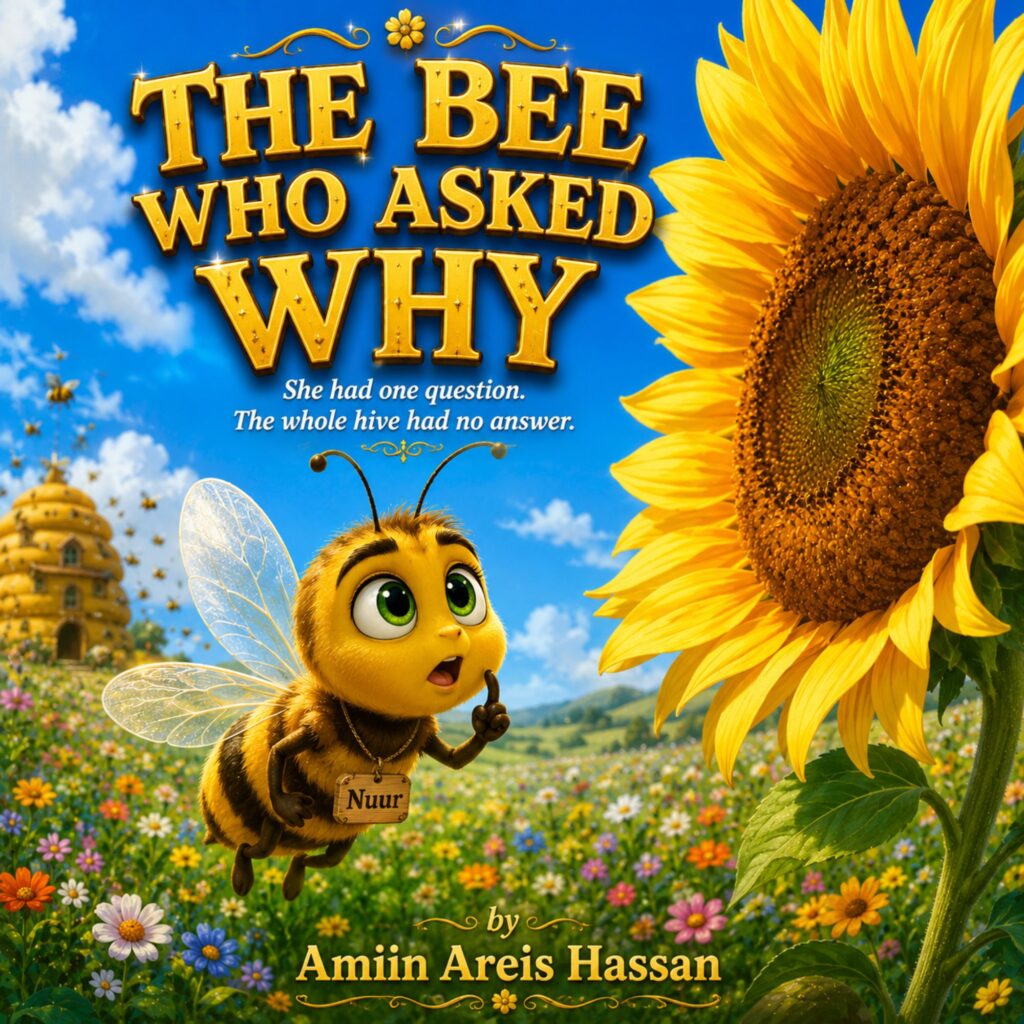
Most children ask why constantly. Then somewhere along the way, adults stop answering properly. “That’s just how it works.” “Because I said so.” “Just do it.” Nuur, the young bee at the center of this picture book by Amiin Areis Hassan, gets the bee version of that answer early on. Her job is collecting nectar. […]
Most children ask why constantly. Then somewhere along the way, adults stop answering properly. “That’s just how it works.” “Because I said so.” “Just do it.” Nuur, the young bee at the center of this picture book by Amiin Areis Hassan, gets the bee version of that answer early on. Her job is collecting nectar. When she stops to ask why flowers make nectar, why bees make honey, why any of this matters, the older bees have one reply: just fly and collect. That is what bees do.
Nuur does not accept that. This children’s book about curiosity follows what happens when she goes looking for a real answer, finds an elder who actually knows things, and comes back changed. By the last page, the entire hive is different because one bee refused to stop asking why.
The book is written for children ages 4 to 10, though the science inside it is accurate enough to interest adults who happen to be reading aloud. It is one of the better science-through-story books available for young children right now, and it is worth spending time on.
What Makes Nuur Different From Other Curious Characters in Children’s Books
There is a version of this story where the curious child is simply validated. She asks questions, adults nod encouragingly, everyone agrees curiosity is good. That version is comfortable. It is also a little empty, because it does not actually answer any questions. What makes this book work differently is that Nuur’s curiosity leads somewhere real.
When the older bees brush her off, she finds Jabali, the oldest bee in the hive, who has seen three hundred summers. He does not tell her to stop asking. He also does not give her a vague answer about how wonderful questions are. He answers the question. Flowers make nectar because they cannot move and cannot carry their own seeds. They need bees to come to them. So they produce something sweet, bees eat it and carry their pollen, and both species survive because of the arrangement. Neither can live without the other.
That explanation lands differently than “curiosity is good, keep asking.” It shows Nuur what asking actually produces: genuine understanding. The book’s central argument is not that questions are nice to have. It is that questions, when pursued seriously, change how you see everything around you.
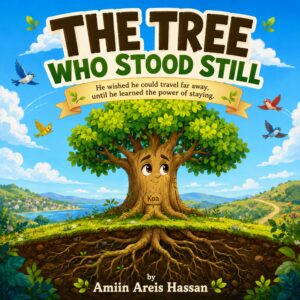
You might also enjoy: The Tree Who Stood Still, another book by Amiin Areis Hassan, for children thinking about what it means to stay steady and grow deep roots.
The Science in the Story: What Children Actually Learn
This is where the book earns its place in a classroom or on a bookshelf alongside science titles. The science is real, it is explained clearly, and it does not talk down to children.
The pollination relationship between bees and flowering plants is one of the most important biological partnerships on earth. Roughly one third of the food humans eat depends on pollinators, and bees carry the largest share of that work. The mechanism the book describes, flowers producing nectar to attract bees who then carry pollen from plant to plant, is exactly how it works. The book presents this as a trade, which is biologically accurate and also intuitively understandable for young children. You get something, I get something, and we both need the arrangement to continue.
The honey surplus question is less commonly explained to children and the book handles it well. Nuur asks why bees make more honey than they eat. The answer is winter. When nothing flowers, the hive needs stored energy. The extra honey is not excess. It is preparation for a season that has not arrived yet. The book frames this beautifully: in the middle of summer, with the blue sky overhead, winter is already waiting somewhere. The honey the hive builds now is a message to their future selves: we thought of you.
The waggle dance is the third piece of science the book covers, and it is the one that tends to make children the most excited once they understand it. Bees communicate the location of flowers to other bees through a specific movement pattern. The angle of the dance indicates direction relative to the sun. The duration of the waggling segment indicates distance. It is a spatial language performed by a creature with a brain the size of a sesame seed, and it works reliably enough that scientists have been able to decode it and predict where bees will fly next. When Jabali asks Nuur how you tell someone something you cannot say in words, and she answers “you show them,” she has arrived at the correct description of one of the most remarkable communication systems in the natural world.
For parents and teachers: after reading, look up a short video of the waggle dance. Children who have read this book will watch it completely differently than children who have not. They will already know what it means.
Why This Book Matters for Children Ages 4 to 10
Asking why is something children do naturally and persistently, especially between ages 3 and 6. Research on children’s questioning behavior consistently shows that the quality of answers they receive shapes whether they keep asking. Children who get genuine answers develop more sophisticated follow-up questions. Children who are brushed off or given non-answers tend to ask less over time.
The older bees in this book are not villains. They are not mean. They just never thought to ask why themselves, so they have no answer to give. That is a portrait most adults will recognize, either from their own childhood or from moments when they have been on the other side of it. The book does not moralize about this. It simply shows what is lost when the asking stops, and what becomes possible when it does not.
Nuur’s questions do not just satisfy her own curiosity. They improve the hive. By the end of the story, the honey that summer is the sweetest in a hundred years, and Jabali explains why with a line worth remembering: bees who understand what they are doing have always done it better. That is not a children’s book moral. That is a principle that applies to engineering, medicine, farming, teaching, and most other things worth doing well.
For younger children, ages 4 to 6, the story works through its emotional logic. Nuur wants to know. Nobody tells her. She goes and finds out. That sequence is satisfying in the way good stories are, independent of the content. Children feel Nuur’s frustration with the non-answer and her excitement when she finally gets the real one.
For ages 6 to 8, the science becomes the focus. The pollination explanation, the winter preparation, the waggle dance. These are real things children can look up, test, and discuss. The book gives them a framework for caring about the answers.
For ages 8 to 10, the distinction Jabali makes on page nine is worth a longer conversation. Bees who never ask why are good workers. Bees who ask why become teachers. Bees who ask why and then go find out are the ones who change things. Ask a child which one they want to be, and then ask them what they are currently doing about it.
How to Use This Book at Home and in the Classroom
At home, the most useful thing you can do after reading is refuse to let the conversation stop at the book’s last page. Pick one of Nuur’s questions and actually look it up together. Why do flowers make nectar? Why is honey different from other foods? What exactly is the waggle dance? Treating the book as a starting point rather than an endpoint models exactly the behavior Nuur demonstrates, and it makes the book’s lesson real rather than abstract.
Another approach is to ask your child what their version of Nuur’s question is. Not about bees, but about anything. What is something they do every day without knowing why? Brushing teeth. Wearing a seatbelt. Eating breakfast. Most children have never actually been told the real answer to any of these, and finding out together is the same experience Nuur has in the book.
In the classroom, the book works well as the opening of a unit on ecosystems and interdependence. The bee and flower relationship is a clean, concrete example of mutualism, one of the foundational concepts in ecology. After reading, students can map other mutualistic relationships in nature: clownfish and sea anemones, oxpeckers and large mammals, mycorrhizal fungi and tree roots. The same structure the book uses for bees and flowers works across all of them.
The waggle dance is also a natural lead-in to lessons about communication, language, and information. How do different animals communicate? What can be communicated without words? Children can try to design their own wordless communication system and then compare it to the waggle dance. It is a genuinely engaging activity that is harder than it looks.
You might also enjoy: a list of the best science read-alouds for ages 4 to 10, books that teach real biology and ecology through story rather than worksheet.
Discussion Questions for Parents and Teachers
For ages 4 to 6: Why did the older bees tell Nuur to just fly and collect? Do you think they were trying to be mean?
For ages 4 to 6: What did Jabali tell Nuur about why flowers make nectar? Does that make sense to you?
For ages 6 to 8: Why do bees make more honey than they eat right now? What are they thinking about that the other bees were not?
For ages 6 to 8: The waggle dance tells other bees where to find flowers. How do you think bees figured out how to do that?
For ages 8 to 10: Jabali says bees who ask why and then go find out are the ones who change things. Can you think of a real person who did that? What did they change?
For ages 8 to 10: Nuur did not keep her knowledge to herself. She told Daawo, and the whole hive changed. Why does sharing what you learn matter as much as learning it?
For all ages: What is one question you have right now that nobody has given you a real answer to?
Similar Books Worth Reading
For children who responded to the science and curiosity in this book, these titles cover related ground in different ways.
Ada Twist, Scientist by Andrea Beaty follows a young girl who cannot stop asking why and turns her curiosity into experiments. The approach is noisier and more chaotic than Nuur’s, but the underlying impulse is the same. National Geographic Little Kids First Big Book of Science is a strong non-fiction companion if a child wants to keep going after this book. What Do You Do With a Problem? by Kobi Yamada is a good pairing for children who feel discouraged when questions do not get answered easily. Honeybee: The Busy Life of Apis Mellifera by Candace Fleming is a beautifully illustrated non-fiction book about bee biology for slightly older readers who want more after this story. The Lorax by Dr. Seuss is a longer reach thematically, but it deals with the same ecosystem interdependence at its core, and children who understood the flower-bee relationship will find it resonates differently.
Why This Book Deserves a Place on Your Shelf
The simplest test for whether a children’s book is worth buying is whether it leaves the child with something real. A feeling, an idea, a question of their own, something that was not there before. This book passes that test.
Nuur’s journey from “just fly and collect” to understanding the full system she is part of is a genuinely satisfying arc. The science is accurate. The elder who helps her is wise without being preachy. The ending, where the whole hive hums with questions and produces the sweetest honey in a hundred years, does not feel forced. It is the natural result of what understanding does to performance.
The illustration on the final spread, where bees swarm around the hive entrance with “why” and “how” and “what if” floating above them, is the kind of image children point to when they see it. They want to be in that hive. That is exactly the right response.
Bees who understand what they are doing have always done it better. That applies to children too, and to the adults reading this aloud to them.
You can find The Bee Who Asked Why and the complete collection by Amiin Areis Hassan at zolopi.com. For classroom orders and educational partnerships, contact info@zolopi.com.