Children's Book
Finn and the Broken Shell: A Children’s Book About Change, Growing Up, and Finding New Beginnings
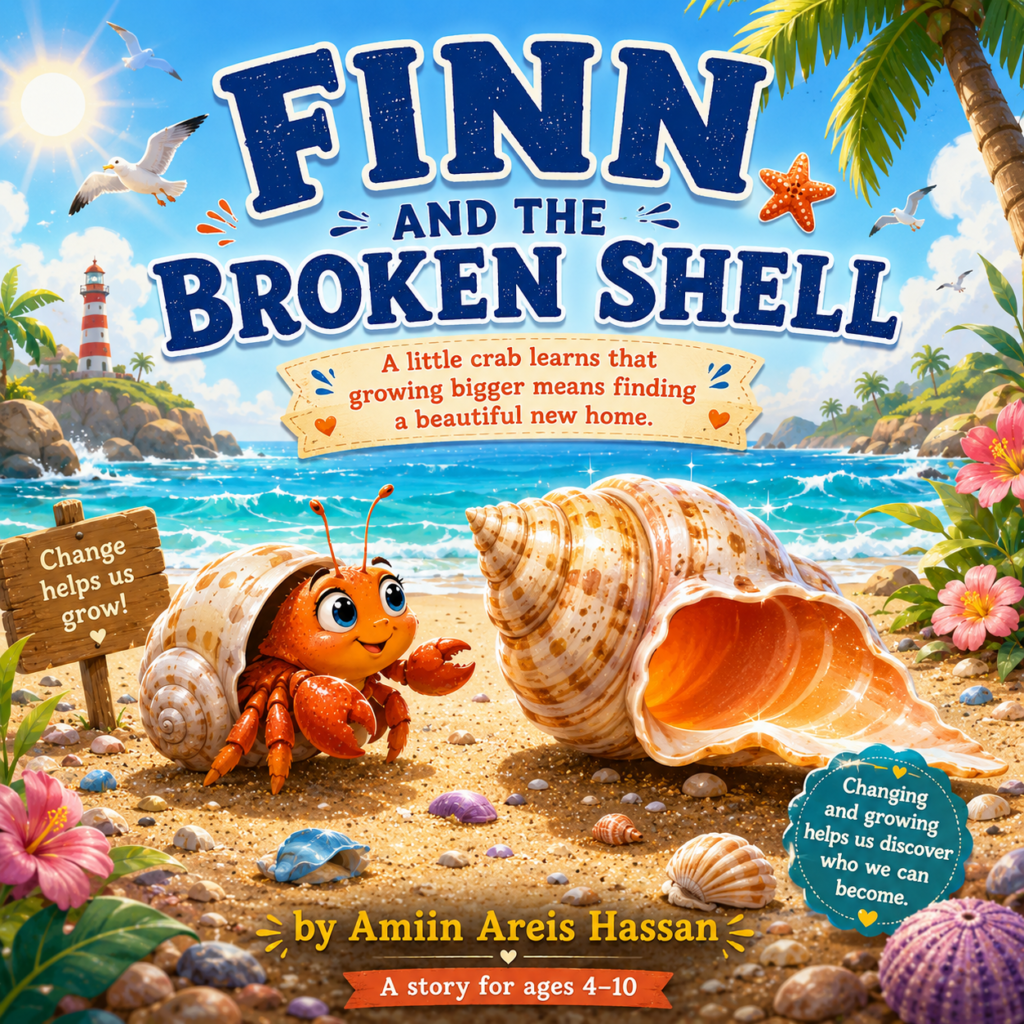
Finn discovers a cracked shell and learns that some things have to break before they can grow. A gentle, honest story about change for children aged 4 to 10. Free to download and keep.
Finn is a small orange hermit crab who loves his shell. It is tight and safe and keeps him warm from the wind. He carries it everywhere. It is his home, and for a while it fits perfectly. Then one day it does not. He has been eating well and growing, the way young creatures do, and suddenly the shell that felt like safety feels like a trap. It cracks. He has to leave.
That moment, when something that once protected you becomes the thing holding you back, is one of the most honest descriptions of a transition that children’s picture books ever attempt. Finn and the Broken Shell, written by Amiin Areis Hassan and aimed at ages 4 to 10, follows what happens next. It is a children’s book about change that earns its hopeful ending by not skipping past the hard part. Finn feels small and cold and worried when he steps onto the sand without a shell. The book sits with that feeling long enough for it to mean something. And when Finn finally slides into a new home and runs along the beach with joy, it feels true rather than easy.
This is the book to read with a child before a new school year, a house move, a new sibling, or any transition that has them holding tightly to what they already know.
What Makes This Book Different From Other Change Stories for Kids
Most picture books about change follow a simple arc: change happens, child is scared, child finds it was fine all along. The fear is acknowledged briefly and then resolved. The message, delivered gently, is that change is not really that bad.
This book respects the fear more than that. When Finn steps out of his cracked shell, he does not immediately spot the new one. He crawls across the sand feeling strange and cold and small. He worries he will not find another home. That sequence takes up real page space, and it should, because children in transitions feel exactly this: not just scared of the new thing, but genuinely unsure whether the new thing will exist at all.
The book’s central insight is not that change is fine. It is that growth makes change necessary, and necessary things can be survived. Finn did not break his shell by doing something wrong. He broke it by growing. His shell cracked because he ate his seaweed and got bigger and stronger, which is exactly what young creatures are supposed to do. The very thing that caused his problem was healthy. Children navigating their own transitions need to hear that the discomfort they feel is not a sign something has gone wrong. It is often a sign they have grown.
The moment Finn hesitates in front of the new spiral shell is the most psychologically honest page in the book. The new shell is beautiful. It is clearly the right size. And he still hesitates, because change always feels a bit scary. He does not step in because his fear disappears. He steps in despite it. That distinction matters for children who are waiting to feel ready before trying something new.
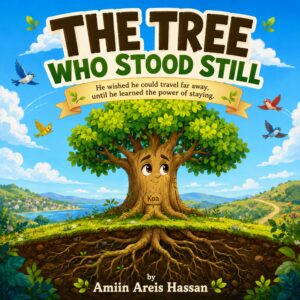
[You might also enjoy: The Tree Who Stood Still, another book from Amiin Areis Hassan, about a young tree who learns that staying with what you are can be its own kind of strength.]
The Science Behind the Story: What Hermit Crabs Actually Do
The biology in this book is real, and it makes the story richer once you know it. Hermit crabs are unusual animals in one specific and important way: they are born without a permanent shell. Their abdomens are soft and unprotected, which means they depend entirely on finding and inhabiting shells made by other animals, typically sea snails. They cannot survive long without one.
This arrangement means that every hermit crab, throughout its life, must do exactly what Finn does. It must periodically leave a shell it knows and trusts, expose its vulnerable body to the open environment, and move into a new shell it has not yet learned to carry. This is not a rare event or a special circumstance. It is a biological requirement that happens again and again as the animal grows. A hermit crab that refuses to switch shells when it outgrows them will eventually be unable to protect itself at all.
The brief wobbling Finn experiences after entering the new shell is also accurate. A hermit crab moving into a larger shell takes time to adjust to the new weight and dimensions. The legs that learned to carry one shell have to relearn balance for another. That adjustment period is real, and the book captures it with the detail that good science-through-story requires.
What children absorb from this, even without knowing they are learning biology, is that vulnerability between homes is a normal part of growth. Not a failure. Not a punishment. A stage that every growing creature moves through on the way to something bigger.
Why This Book Matters for Children Going Through Transitions
Children face transitions constantly. Starting school. Moving to a new house. A new teacher, a new class, a new city. A sibling arriving. A friendship ending. A routine disappearing. Each of these has a version of the cracked shell: the old situation no longer fits, and the new one has not been found yet. That in-between moment is the one children find hardest to tolerate, and the one adults most often rush them through.
Research on children and transitions consistently finds that what children need most in periods of change is not reassurance that everything will be fine. What they need is acknowledgment that the uncertain middle is real, that feeling small and cold on the sand without a shell is a genuine experience worth naming, and that the discomfort does not mean they are failing at the transition. Finn and the Broken Shell does exactly this, without using any of those words.
For children ages 4 to 6, the story works through its emotional honesty. Finn is scared. He is small. He finds something beautiful. He hesitates. He tries anyway. That arc is one children can follow and feel without needing to analyze it. The illustrations carry as much emotional information as the text, and reading aloud gives parents a natural opening to ask how a child is feeling about their own changes.
For ages 6 to 8, the hermit crab science adds a layer that makes the story more useful. Knowing that this is what hermit crabs actually do, that every one of them has been exactly where Finn is, gives children a frame for their own experience. They are not uniquely fragile. They are doing what growing creatures do.
For ages 8 to 10, the line Finn reaches at the end is worth staying with: leaving his old shell was the only way to grow. Not one way. The only way. That is a harder idea than it sounds. It means the discomfort was not optional. It means you cannot grow and stay exactly the same at the same time. Older children can engage with what that means for something specific in their own lives.
The Moment Finn Looks at His Reflection
Page ten is the one to slow down for. Finn looks at himself in a quiet pool of water. He looks grand and safe in his new shiny home. And he realizes that leaving his old shell was the only way to grow.
The pool of water as mirror is a good choice. It is not a reward or a prize. It is just Finn, seeing himself clearly for a moment, recognizing what the experience produced. He is not celebrating because the scary part is over. He is recognizing that the scary part was necessary. The distinction is subtle and important, and the illustration makes it visible without explaining it.
Children who struggle with change tend to focus on the moment of leaving, the cracked shell, the cold sand, the worry. This page redirects attention toward the version of themselves that comes after. It asks: what if the discomfort of the transition is the thing that makes the new version of you possible? Not despite the hard part, but because of it.
You might also enjoy: The Fish Who Could Not See Water, another book from Amiin Areis Hassan, about a young fish who discovers that the most important things in his life were the ones he had stopped noticing.
How to Use This Book at Home or in the Classroom
At home, the most useful question to ask after reading is not “are you scared about your change” but “what is your old shell?” Ask your child what thing they are holding onto that might be getting tight. It might be a habit, a routine, a friendship that has shifted, a version of themselves they have outgrown. The book gives them language for something they may not have had words for before.
If a specific transition is coming, read this book before it happens, not after. Finn’s story is most useful when the cracked shell is already visible but the new one has not been found yet. That is when children most need to know that walking on the sand without a shell, however strange and cold it feels, is a normal stage with an end.
In the classroom, this book anchors conversations about growth and change that go beyond the typical comfort-oriented approach. Ask students: what is something you have outgrown? What did it feel like to leave it behind? What did you find instead? These are real questions with real answers, and most children have experiences they can draw from. The hermit crab provides enough emotional distance that children who are currently in a difficult transition can engage without feeling exposed.
A science extension: research hermit crab shell-switching behavior. There are well-documented cases of hermit crabs forming “vacancy chains,” where multiple crabs line up in size order and exchange shells simultaneously, each one moving into the next size up. It is a cooperative solution to a shared problem. That detail adds an interesting dimension to the story: Finn found his new shell alone, but in nature, crabs often navigate this transition together.
Discussion Questions for Parents and Teachers
For ages 4 to 6: Why did Finn’s shell crack? Did he do something wrong?
For ages 4 to 6: How did Finn feel when he was walking without a shell? Have you ever felt like that?
For ages 6 to 8: Finn hesitated before going into the new shell, even though it looked perfect. Why do you think he did that?
For ages 6 to 8: His strong legs had to learn how to balance the new shell’s weight. Can you think of something new you had to practice before it felt normal?
For ages 8 to 10: Finn realized that leaving his old shell was the only way to grow. Can you think of something you have outgrown? What did it feel like to leave it?
For ages 8 to 10: If Finn had tried to stay in his cracked shell, what would have happened? Can you think of a time when staying with something familiar was actually making things worse?
For all ages: What is your new shell right now? Something new or bigger that you are still learning to carry?
Similar Books Worth Reading
For children who connected with Finn’s story, these books explore change, transitions, and growth from different angles.
The Invisible String by Patrice Karst reassures children that moving to a new place or situation does not break the connections that matter. What Do You Do With a Problem? by Kobi Yamada is a quiet companion piece about a child who avoids a problem, then discovers it contained something valuable. Beautiful Oops by Barney Saltzberg reframes mistakes and unexpected changes as the beginning of something new rather than the end of something good. The Dot by Peter H. Reynolds follows a child who makes one small mark and finds, to her surprise, that it is enough to start with. On the Night You Were Born by Nancy Tillman is gentler and more appropriate for very young children facing the arrival of a sibling or another major change.
Why This Book Is Worth Buying and Keeping
There are a lot of children’s books about change. Most of them are kind and well-intentioned and not quite honest enough. They skip the cold sand. They cut from the cracked shell directly to the happy ending.
This book does not skip anything. Finn spends real time on the beach without a shell, feeling small and worried. He hesitates in front of the new one. He wobbles when he first tries to carry it. And then he looks at himself in the water and understands something that parents have been trying to explain to children for as long as there have been children: the thing that scares you is also the thing that makes you bigger.
The hermit crab is the right vehicle for this story because it makes the biology of change unavoidable. Finn did not choose to need a new shell. He grew. That is what creatures do. The question was never whether he would need to leave the old shell. The question was whether he would be brave enough to go.
He was. And the world did have a perfect new home for him when he was ready.
You can find Finn and the Broken Shell and the complete collection by Amiin Areis Hassan at zolopi.com. For classroom orders and educational partnerships, contact info@zolopi.com.