Children's Book
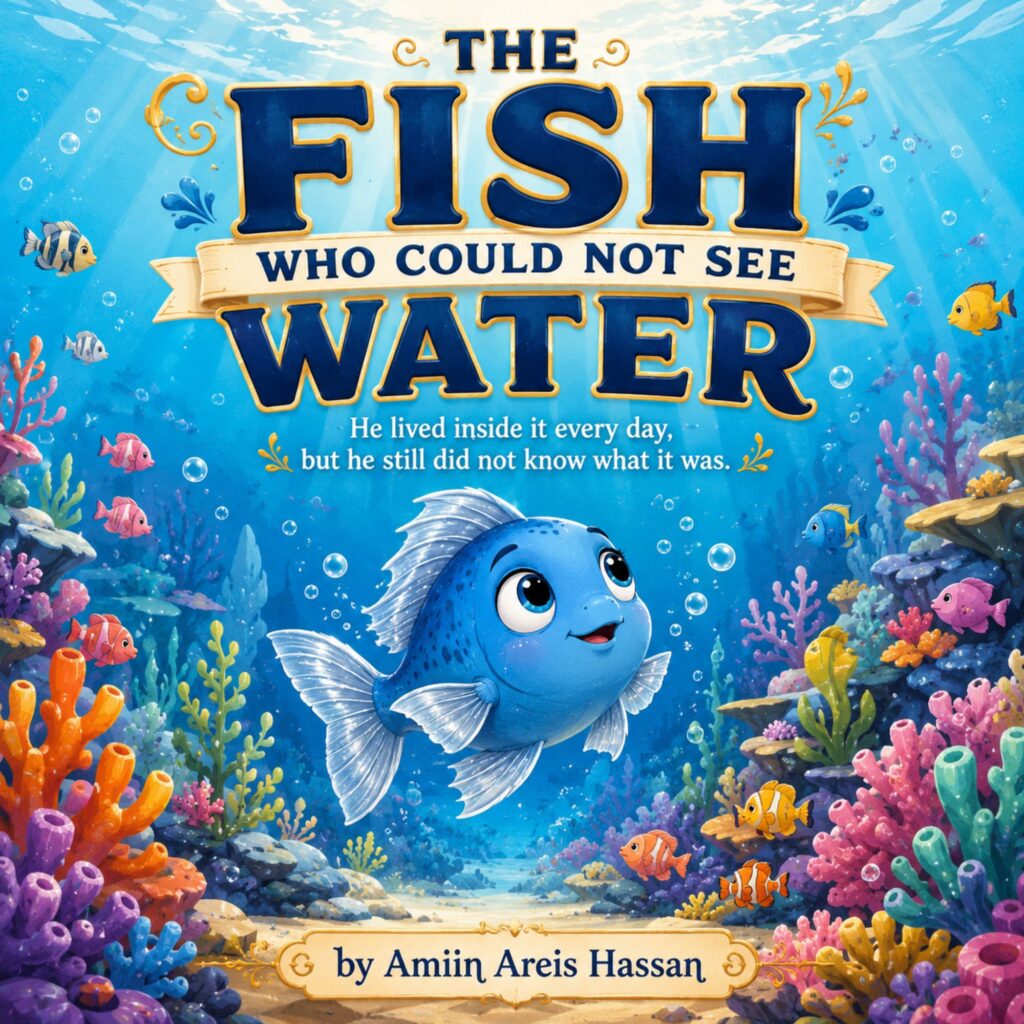
The Fish Who Could Not See Water: A Children’s Book About Gratitude and Seeing What Is Already There
There is a question hidden inside this book that most adults have never answered for themselves. Finn, a young blue fish living in a warm coral sea, stops swimming one day and asks: what is water? The fish around him blink in surprise. They tell him he is inside it. He looks carefully. He cannot […]
There is a question hidden inside this book that most adults have never answered for themselves. Finn, a young blue fish living in a warm coral sea, stops swimming one day and asks: what is water? The fish around him blink in surprise. They tell him he is inside it. He looks carefully. He cannot see it. He searches behind sea plants and inside caves all day long. Still, nothing.
That setup sounds like a riddle, and in some ways it is. But The Fish Who Could Not See Water, written by Amiin Areis Hassan, is not really about water. It is about the things so close to us, so constantly present, that we have stopped being able to see them at all. It is a children’s book about gratitude that takes the long way to get there, through confusion and searching and one unexpected wave, and the long way turns out to be exactly right.
The book is aimed at children ages 4 to 10. It works as a bedtime story, as a classroom read-aloud, and as the kind of book that starts a conversation you were not expecting to have.
What Is This Book Really About?
Finn’s problem has a name in psychology. Researchers who study attention and perception call it habituation: the process by which the brain stops registering things that are always present. It is an efficient system. If the brain fully processed every sensation all the time, including the feeling of clothes on your skin, the hum of a refrigerator, the weight of your own body in a chair, thinking would become impossible. So the brain filters out the constant and only alerts you to the new.
The trouble is that habituation does not distinguish between things that are unimportant and things that matter deeply. Love can habituate. Safety can habituate. Home can habituate. The water Finn cannot see is a perfect physical model for this: it is literally everywhere, it sustains everything he does, and he has become so accustomed to it that he genuinely cannot perceive it.
The book does not explain any of this directly. It does not need to. Finn’s search, his frustration, his failure, and then the sudden wave that lifts him above the surface and gives him his first view of the sea from the outside children feel all of that before they understand it. The insight arrives as an experience, not a lesson, which is why it tends to stay.
The last lines of the book describe Finn swimming farther than ever before, with the sea feeling both bigger and somehow closer at the same time. That paradox is exactly right. Understanding something changes your relationship to it. The sea did not change. Finn changed. And nothing about his world is ordinary to him anymore.
Why This Is One of the Most Unusual Gratitude Books for Kids Available
Most children’s books about gratitude follow a predictable structure. A character has something, loses it, gets it back, and is thankful. The lesson is delivered clearly, usually in the final pages, sometimes with a direct statement from a narrator or a wise adult character.
This book does none of that. There is no loss. Finn does not lose his sea. He gains the ability to see it. The distinction matters because losing something and then getting it back teaches children that gratitude is the appropriate response to recovery from hardship. That is true, but incomplete. This book teaches something harder and rarer: that you do not need to lose something to appreciate it. You need to find a way to see it clearly.
The wave that throws Finn above the ocean is not a loss. It is an interruption. A moment of distance that makes the familiar suddenly visible. That is a different kind of invitation, and one that children can actually use in daily life. You do not have to wait until something is taken from you. You can choose to look at it differently right now.
You might also enjoy: The Bee Who Asked Why, another book by Amiin Areis Hassan, in which a young bee discovers that understanding the purpose behind everyday things changes how you experience them entirely.
What Children Learn From This Book at Different Ages
For children ages 4 to 6, the story works on its most immediate level. Finn wants to find something and cannot. A wave changes everything. He goes back to his sea and it feels different. That arc is emotionally satisfying and easy to follow. At this age, the most useful question to ask afterward is the simplest one from the back of the book: what is something special in your life that you see every day?
For ages 6 to 8, the book opens up a genuinely interesting conversation about how seeing works. Why could Finn not see the water even when he was told he was inside it? Children at this age have enough experience with attention to understand, in their own words, that you stop noticing things you are used to. Ask them what they have stopped noticing. Their answers tend to be better than adults expect.
For ages 8 to 10, the philosophical question the book circles is worth naming directly: is it possible to be grateful for something you cannot see? Finn could not be grateful for water he did not know existed. He had to become able to see it first. This is a real problem in philosophy and in everyday emotional life, and older children can engage with it seriously. What are the things in their own lives that might be invisible to them right now because they have always been there?
The book also connects naturally to science conversations at this age. Why does the brain stop registering constant stimuli? What is the purpose of that filtering process? How do scientists study what people do and do not notice? The concept of habituation is taught at various levels from middle school onward, and this book gives children a memorable, concrete illustration of it years before they encounter the formal term.
The Moment That Makes This Book Work
The illustration on page seven is the one parents and teachers should slow down for. Finn, launched above the ocean by a wave, looks down in shock. The giant blue water stretches in every direction. At last, he could see it.
That image does something the text alone cannot. Children who have ever been to the ocean and looked at it from shore, from a boat, from a hill above a beach, will feel what Finn feels. The scale of it. The fact that it goes on. When you are inside something, you experience it as immediate, local, particular. When you are briefly outside it, you experience it as vast, total, irreplaceable. Both experiences are real. Finn needed both to understand what he had.
The moment Finn falls back into the sea and everything feels different is one of the most well-constructed endings in recent children’s picture books. Nothing changed. The sea is exactly what it was. But Finn is not exactly what he was, and so the sea is new to him.
How to Use This Book at Home or in the Classroom
At home, the most direct extension of this book is to try what Finn had to learn by accident: deliberate noticing. After reading, ask your child to spend two minutes just paying attention to something they are usually not aware of. The feeling of the floor under their feet. The sounds in the room right now. The light coming through a window. This is a basic mindfulness practice, but framed through Finn’s story, children understand immediately why they are doing it. They are trying to see their water.
Another approach that works especially well for younger children: ask them to draw their version of Finn’s view from above the wave. What would their sea look like if they could see it from the outside? What is in it? This can lead to conversations about family, home, friendship, daily routines, and all the ordinary things that constitute a child’s life. Those conversations are often more revealing than adults anticipate.
In the classroom, this book pairs naturally with lessons about the senses and perception. What do our senses notice? What do they filter out? A simple experiment: ask children to close their eyes and list every sound they can hear right now. Then ask them to notice the feeling of the chair under them, the temperature of the air, the weight of their own hands. Most children will report that they were not aware of most of those sensations before being asked to notice them. Finn’s experience becomes immediately personal.
The book also works as the opening of a unit on gratitude, but taught as a skill rather than a feeling. Gratitude is often presented to children as something you feel after something good happens. This book suggests something different: gratitude is something you practice, and the practice is attention. You have to see your water before you can be glad of it.
You might also enjoy: a list of picture books about mindfulness and attention for children ages 4 to 10, stories that teach children to notice what is already around them.
Discussion Questions for Parents and Teachers
For ages 4 to 6: Why could Finn not see the water even when the other fish told him he was inside it? Have you ever not noticed something that was right there?
For ages 4 to 6: What made Finn finally see the water? How did he feel when he went back into the sea?
For ages 6 to 8: Finn says “sometimes we stop seeing things that stay close too long.” Can you think of something in your life that you might have stopped seeing?
For ages 6 to 8: If the wave had not come, do you think Finn would have ever found the water? What else might have helped him?
For ages 8 to 10: Finn says the sea looked bigger and also felt closer after he saw it from above. How can something feel both bigger and closer at the same time? Does that make sense to you?
For ages 8 to 10: What do you think your water is? What is something in your life that is always there but that you might not fully see?
For all ages: What is something special in your life that you see every day?
Similar Books Worth Reading
For children who responded to Finn’s story, these books explore related territory in different ways.
Last Stop on Market Street by Matt de la Peña is a beautiful companion piece about a boy learning to see richness in what is already around him, guided by a grandmother who notices everything. The Invisible String by Patrice Karst addresses the invisible connections between people we love, something very much in the spirit of what Finn discovers. Wonder by R.J. Palacio is a longer read for older children, but it deals centrally with learning to see what you have been trained to overlook. The Dot by Peter H. Reynolds is about the moment when one small act of looking carefully changes everything. A Handful of Quiet by Thich Nhat Hanh is a short, practical book for families that want to take the noticing practice this story points toward and actually do it together.
Why This Book Is Worth Reading More Than Once
Most picture books are complete on a single reading. This one rewards returning to. A child who reads it at five will get a story about a fish and a wave. The same child at eight will start to think about what their own invisible water might be. At ten, they might start to name it.
The ending in particular gets richer with re-reading. The sea looked bigger and somehow felt closer. That line does not fully open on a first pass. It takes a child who has had some experience of losing attention to something and then regaining it, even in a small way, to understand what Finn is describing. Which means the book grows alongside the child reading it.
Amiin Areis Hassan writes books that ask children to do real thinking rather than just absorbing a lesson, and this one does that as well as anything in the series. It is quietly ambitious in the best way.
You can find The Fish Who Could Not See Water and the full collection at zolopi.com. For classroom orders or educational partnerships, reach out at info@zolopi.com.