Children's Book
Sol and the Hidden Root: A Children’s Book About Connection, Loneliness, and the Secret Life of Trees
Sol is a little red fox who sometimes feels completely alone. Not because the forest is empty. It is full of animals, tall trees, running water, and birdsong. But when the other animals go to sleep and the forest goes quiet, Sol feels the gap between himself and everything else. He wishes, quietly, for a […]
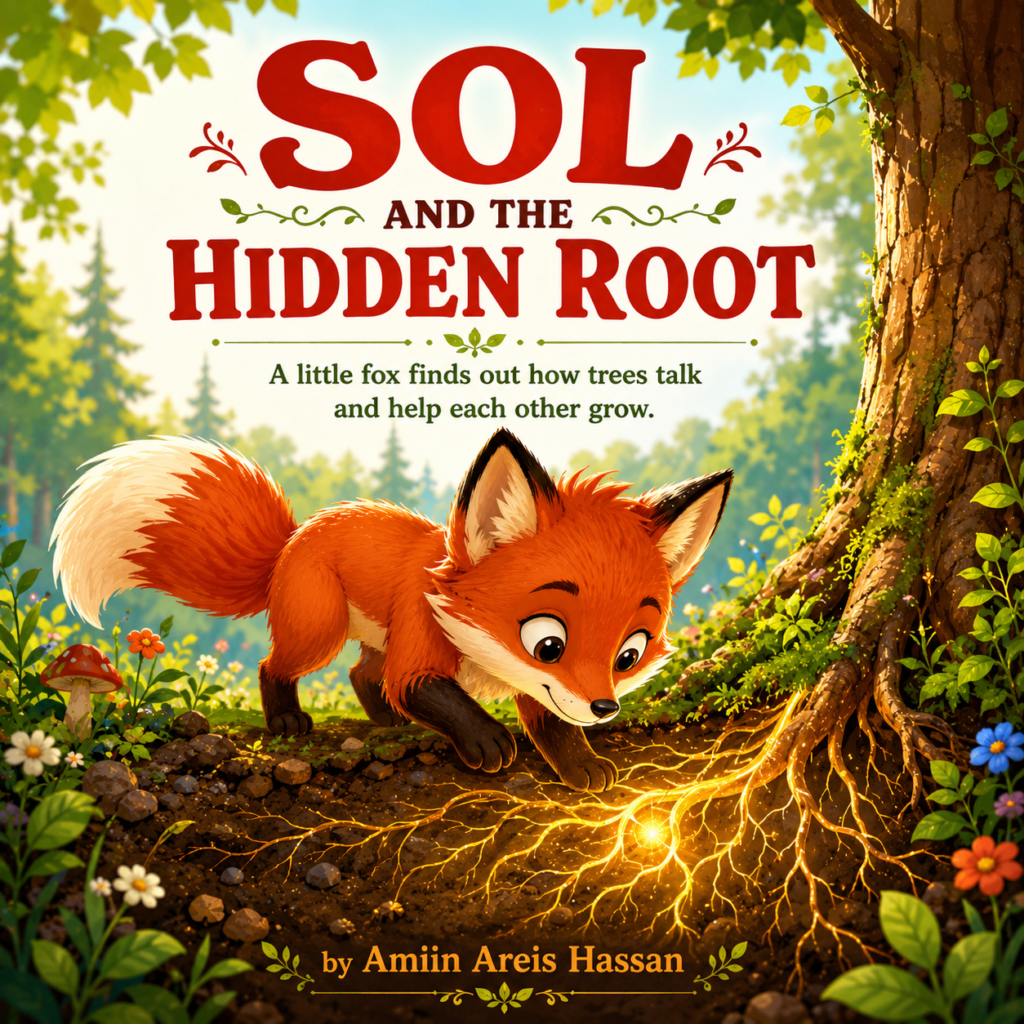
Sol is a little red fox who sometimes feels completely alone. Not because the forest is empty. It is full of animals, tall trees, running water, and birdsong. But when the other animals go to sleep and the forest goes quiet, Sol feels the gap between himself and everything else. He wishes, quietly, for a secret friend.
That opening is one of the more honest descriptions of childhood loneliness you will find in a picture book. It does not dramatize the feeling or rush past it. Sol is not in danger. Nobody has been unkind to him. He is just a small creature in a large world, aware of the space between himself and others. Most children have felt exactly that.
Sol and the Hidden Root, written by Amiin Areis Hassan, follows what happens when Sol digs into the earth one warm afternoon and accidentally discovers that the forest itself has been holding a secret. The trees are not as separate as they look. They are connected underground by a living network they use to share food, send help to the sick, and care for each other across great distances. Sol realizes, by the end, that he is part of a network too. Love was their secret network, the book says. The trees never were truly alone. Neither was Sol.
This children’s book about connection and loneliness is aimed at ages 4 to 10, but the science inside it is real and worth understanding at any age.
The Science Behind the Story: What the White Threads Actually Are
What Sol finds underground is not invented for the story. The tiny white threads wrapped around tree roots that the badger calls a secret nature network are real. Scientists call the organism mycorrhizal fungi, and the network they form has been studied seriously since the 1990s, when researchers first confirmed that trees were actively sending nutrients through it.
Here is how it works. Certain species of fungi grow around and into tree roots, forming an intimate partnership that benefits both organisms. The tree provides the fungus with sugars produced through photosynthesis. In exchange, the fungus dramatically extends the tree’s ability to absorb water and minerals from the soil, often reaching far beyond what the tree’s own roots could access. The fungal threads, called hyphae, can be thousands of times thinner than a human hair and extend across enormous areas of forest floor.
The more remarkable discovery came when scientists realized that trees were using this fungal network to exchange resources with each other. A tree in shade, unable to photosynthesize as much as a sun-lit tree, could receive carbon-based sugars from neighboring trees through the network. When a tree is stressed by drought, pest damage, or disease, connected trees nearby will increase their output to it. Older trees, sometimes called mother trees in the scientific literature, appear to send disproportionately more carbon to younger seedlings of their own species.
This is not metaphor. Trees in connected forests genuinely care for sick neighbors in a measurable, documented way. The book describes this accurately and in terms that four-year-olds can follow. When one tree is sick, the others send it sugar through the roots. They take care of each other even if they are far apart.
The forest was like one big family, Sol thinks. That line is biologically defensible.
Why This Book Works for Children Who Feel Lonely
Loneliness in childhood is more common and more varied than adults tend to recognize. A child can feel lonely in a classroom full of people, at a family dinner, or on a playground where nobody is being mean to them specifically. The loneliness Sol experiences at the start of this book is that kind: ambient, quiet, not attached to any particular event or person. The forest is full and he still wishes for a secret friend.
Most books address loneliness by providing a friend. The lonely character meets someone new, they bond, the problem is solved. That resolution is satisfying and also limited, because it suggests that loneliness is a deficit in your social circumstances that another person can fill. This book offers a different frame.
Sol’s loneliness does not end because he finds a friend. It ends because he discovers he was already connected to more than he knew. The network was under his feet the whole time. His mother, his friends, the forest around him, the other fox who barks back from across the trees: these connections existed before Sol dug the hole. He just could not see them. The book teaches children that connection is not only something you find. It is something you learn to notice.
That is a more resilient answer to loneliness than most children’s books offer. A child who understands that they are already held by invisible connections has a different relationship to quiet moments alone than a child who has only learned to wait for someone to arrive.
What This Book Teaches at Different Ages
For children ages 4 to 6, the story works through its warmth and its images. The glowing threads between roots, the trees with soft faces leaning toward each other, Sol walking home with a happy heart: the book communicates its emotional meaning through illustration as much as text, and young children will absorb the feeling of being held by something unseen before they have words for what that means.
For ages 6 to 8, the science becomes a real conversation starter. The concept of fungi as a go-between, linking tree roots across the forest floor, is genuinely surprising to children this age and tends to produce the kind of excited disbelief that signals real learning. Are trees really talking to each other? Can they actually feel when another tree is sick? These are excellent questions with real answers, and the book provides enough of a foundation to make the conversation go somewhere.
For ages 8 to 10, the analogy Sol draws near the end of the story is worth examining closely. He looks at what the trees have, this invisible network that holds the whole forest together, and realizes that he has something equivalent. His connections to his mother and his friends are real even when he cannot see them, even when the forest is quiet and he feels alone. That parallel between forest biology and human emotional life is not decoration. It is the book’s central insight, and older children can sit with it seriously.
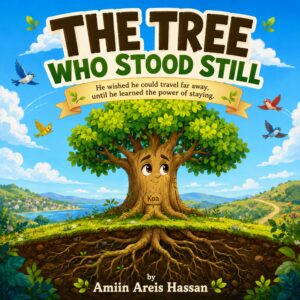
You might also enjoy: The Tree Who Stood Still, another book from Amiin Areis Hassan, which looks at what a tree’s roots make possible over a lifetime of staying in one place.
How the Mycorrhizal Network Changes How You See a Forest
One of the things this book does that most children’s nature books do not is give children a reason to look at the ground. Forests are usually presented to children as vertical: tall trees, birds in branches, light filtering down through leaves. The interesting things are up. Sol and the Hidden Root points downward, and what it finds there reorganizes the whole picture.
A forest is not a collection of individual trees competing for light and water. It is, more accurately, a community of organisms sharing resources through a network most of us will never see. Old trees and young trees in the same forest may be chemically connected. A seedling that would otherwise fail in deep shade can survive because connected neighbors are subsidizing it. When you clear-cut a forest, you destroy not just the trees but the network they depend on, which is one reason forests that grow back after clear-cutting take so long to become genuinely functional ecosystems again.
Children who understand this look at a forest floor differently. Every mushroom becomes a hint at the network below. Every patch of moss on a root becomes interesting. The book hands children a new lens for an environment they may have walked through dozens of times without fully seeing.
A simple follow-up activity: find any mushroom outdoors with your child. Explain that the mushroom is only the visible part. The rest of the organism, the threads connecting everything, is underground and invisible. Most of what the mushroom is cannot be seen. The mushroom is, in this sense, like Sol: part of a much larger network that goes on quietly without anyone necessarily noticing.
How to Use This Book at Home or in the Classroom
At home, the most direct conversation after reading is the one Sol has with himself near the end: who are the people in your network? Not online, not in general, but specifically. Your child’s mother, grandmother, the friend they call when something good happens, the teacher who noticed something. Children who can name the people in their network carry that knowledge differently than children who only have a vague sense of being loved.
The book also handles the fear of loneliness in a way worth addressing directly with children who struggle with it. Sol felt alone when the forest went quiet. But the network was always there. For a child who fears being alone at night, or who dreads school mornings, or who has recently experienced a change in their social world, that image of a hidden connection that persists even when you cannot feel it can be genuinely comforting, more so than being told not to worry.
In the classroom, this book is a natural anchor for a unit on ecosystems and interdependence. The mycorrhizal network is one of the most striking examples of mutualism in nature, and it is almost entirely invisible to casual observation, which makes it memorable when children finally learn about it. Start with the book, then extend into actual fungal biology. What is the difference between a mushroom and the organism it is part of? How do scientists study things they cannot see directly?
The book also works well as a starting point for conversations about community and what makes a group of individuals into something more connected. The trees in the forest look like separate organisms. From underground, they are something else entirely. The same question applies to classrooms, families, and neighborhoods.
You might also enjoy: a list of picture books for children about belonging and connection, stories that address loneliness through discovery rather than rescue.
Discussion Questions for Parents and Teachers
For ages 4 to 6: What did Sol find under the ground? Did it surprise you? Why do you think the threads were glowing?
For ages 4 to 6: Sol felt alone sometimes even though the forest was full of animals. Have you ever felt like that?
For ages 6 to 8: The white threads connect one tree root to another far away. Why do you think the trees share food instead of keeping it for themselves?
For ages 6 to 8: Sol filled the hole back in gently at the end. Why do you think he did that? What does that tell you about how he felt?
For ages 8 to 10: Sol realized his connections to his mother and friends were like the tree network. What is the same about them? What is different?
For ages 8 to 10: The trees in the story help sick trees even when those trees are far away. Can you think of a way humans do something similar?
For all ages: Who are the people in your secret network?
Similar Books Worth Reading
For children who responded to Sol’s discovery, these books explore related themes of connection, hidden systems, and what holds a community together.
The Invisible String by Patrice Karst is the most direct companion piece, a story about the invisible threads that connect us to the people we love even when they are not with us. Over and Under the Pond by Kate Messner is a beautifully illustrated non-fiction picture book about what lives beneath the surface of a pond, for children who love finding hidden layers in familiar places. Braiding Sweetgrass for Young Adults by Robin Wall Kimmerer, which has a younger adaptation available, explores the relationships between plants and people with real scientific depth. Last Stop on Market Street by Matt de la Peña touches on seeing the connections and richness already present in your environment. The Lorax by Dr. Seuss is a longer reach but deals with what happens when a connected system is broken, and children who have read Sol’s story will see it differently.
Why This Book Deserves a Long Place on Your Shelf
Sol walks home at the end of the book with a happy heart. Every time he steps on the grass, he remembers the secret underground family. He knows he will never feel lonely in the forest again. That resolution is earned because it did not arrive through a happy accident. Sol dug a hole. He paid attention to what he found. He let a badger explain it. He made the connection to his own life himself. Understanding cured the loneliness more completely than company would have.
That is a lesson children can use for the rest of their lives, and it is embedded in a story about mycorrhizal fungi and a little red fox. The combination should not work as well as it does, and yet it works completely.
The illustrations are worth mentioning separately. The cross-section pages showing glowing threads weaving between root systems underground are the kind of images that children point to and ask about, sometimes days after the book was read. What are those lights? Why are they everywhere? Why can we see them from underground? The questions are the beginning of real learning, and this book produces them reliably.
You can find Sol and the Hidden Root and all of Amiin Areis Hassan’s books at zolopi.com. For classroom orders and educational partnerships, contact info@zolopi.com.