Children's Book
Wren and the Winter Bud: Children’s Book About Patience and Nature
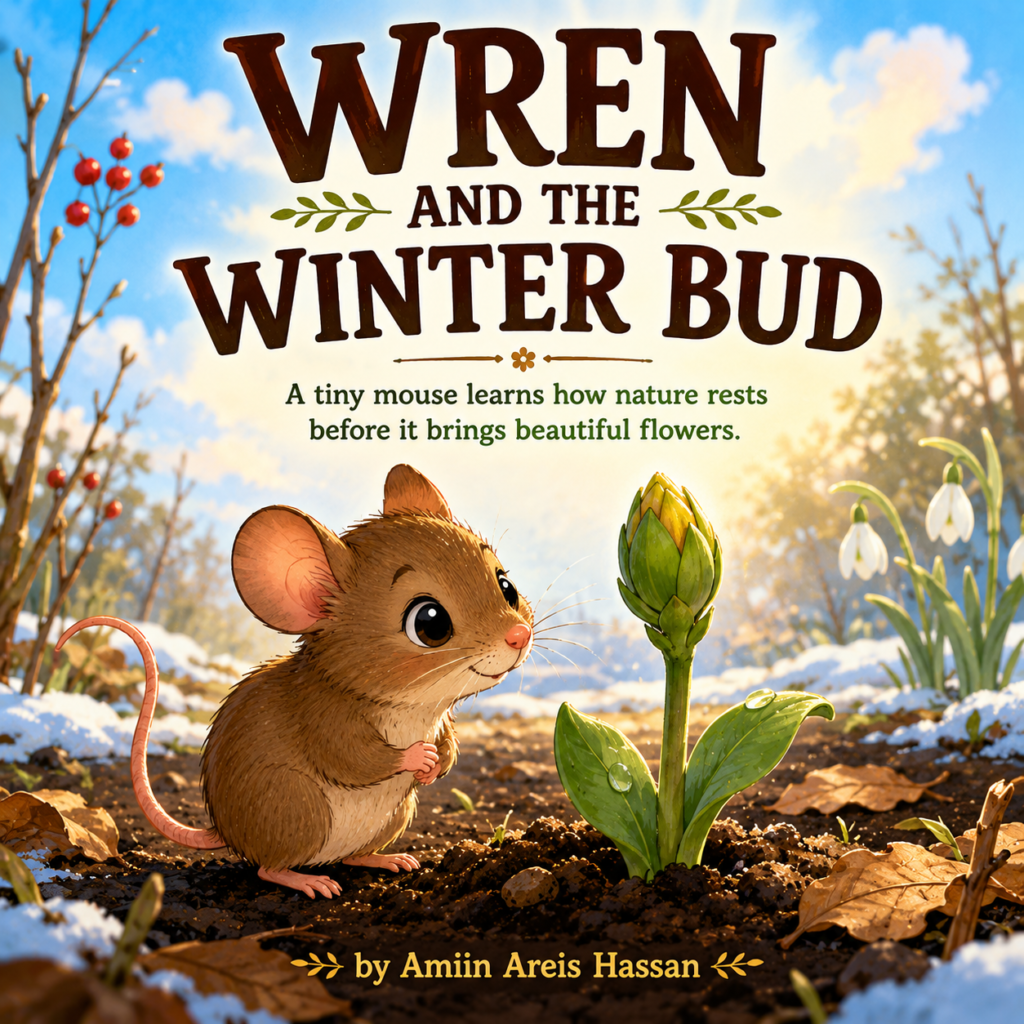
If you have a child who wants everything right now, this book was written for them. Wren and the Winter Bud, by Amiin Areis Hassan, follows a small brown mouse named Wren as he discovers something that no amount of shouting or touching can speed up: a plant growing in its own time. This children’s […]
If you have a child who wants everything right now, this book was written for them. Wren and the Winter Bud, by Amiin Areis Hassan, follows a small brown mouse named Wren as he discovers something that no amount of shouting or touching can speed up: a plant growing in its own time. This children’s book about patience uses the quiet drama of a garden bud to teach children ages 4 to 8 that waiting is not the same as doing nothing. It is one of those rare picture books that slips a real science lesson inside a story so warm and gentle that children absorb it without even realizing it. Parents will find it useful for bedtime, for classroom read-alouds, and for any moment when a child needs to hear that good things come to those who wait.
Who Is Wren, and Why Do Children Love Him?
Wren is not a hero who does everything right. He is a tiny brown mouse who hates to wait. He plants seeds and wants berries on the same afternoon. He finds a closed green bud and shouts at it. He pokes it with his paw. Nothing happens. Wren is, in short, exactly like most four-year-olds.
That is precisely why children connect with him so quickly. He does not start out patient. He becomes patient. The story does not preach at him or at the reader. It simply lets him watch, day after day, as the bud holds its secret. And it lets him discover, entirely on his own, that growing is happening whether he can see it or not.
Hassan’s choice to use a mouse is clever. Mice are small. The garden is enormous. A child reading this book sits at Wren’s scale, looking up at flowers that tower above them. That physical perspective makes the patience lesson feel personal rather than abstract. Wren is not a big creature waiting for a small thing. He is a little creature trusting something much larger than himself.
You might also enjoy: Our review of children’s books about the seasons and how nature changes
What Does This Book Teach Children About Plants and Nature?
Wren and the Winter Bud does real science without ever using the word “science.” When Wren asks why the bud will not open, a friendly bumblebee lands on a dandelion nearby and explains. The plant is resting. It is pulling energy from the sun and the soil. It is building something beautiful from the inside out, slowly, invisibly, in its own time.
This is plant dormancy explained to a five-year-old. And it works.
Children who read this book come away understanding that plants are not broken when they look still. They are working. That single idea shifts how a child looks at a bare garden in autumn or a closed bud on a cold morning. It gives them a frame for something that can otherwise seem confusing or sad.
The book also models observation as a skill. Wren begins by demanding results. He ends by sitting quietly in the warm dirt, watching clouds move, checking on the bud each day. That shift from demanding to noticing is exactly the kind of attentional development that early childhood educators encourage in young learners. Picture books that model this kind of calm watchfulness are genuinely useful classroom tools.
For parents raising children who love animals and the outdoors, this book opens a natural conversation about how flowers grow, why trees lose their leaves, and what happens underground and inside stems during the cold months. It is a comfortable, non-threatening entry point into botanical concepts that will reappear in science class for years.
How Does Wren and the Winter Bud Teach Patience Without Being Preachy?
A lot of children’s books about patience hit the reader over the head with the lesson. They state the moral out loud, often more than once. Wren and the Winter Bud does the opposite.
The moral arrives through Wren’s own body. While watching the bud one afternoon, he notices that his tail has grown a little longer. He has been so focused on waiting for the flower that he did not notice he was growing too. This moment is quiet and funny and true in the way that the best picture book moments are true. Growing happens slowly enough that you cannot see it while it is happening. Time works in quiet ways.
That observation does something important. It moves the patience lesson from something external, a flower that needs to wait, to something personal. Wren is not just waiting for the bud. He is growing alongside it. The child reading the book is growing alongside both of them.
This approach aligns with what developmental psychologists call “self-referential learning,” the tendency for young children to absorb lessons most deeply when they can connect them to their own experience. When Wren says that growing happens so slowly you cannot see it while it is happening, a five-year-old who has been told they are getting taller understands exactly what that means. The book meets children where they are.
There are no lectures here. No adult mouse sitting Wren down for a talk. The garden teaches him, and he figures it out himself.
You might also enjoy: Five children’s picture books about growing up that parents and kids both enjoy
Is Wren and the Winter Bud Good for Anxious or Impatient Children?
Yes. Genuinely.
Children who struggle with waiting, children with anxiety, children who find transitions difficult, all tend to be children who need the world to make sense quickly. Uncertainty is hard for them. Wren and the Winter Bud offers something valuable to those children: a story that shows uncertainty resolving, slowly, into something beautiful.
The flower does bloom. The wait is real, but it is not endless, and it is not pointless. Wren smells the open flower and understands that if it had opened on the first day, it would not have been ready. The waiting made it perfect. That is a sentence a child can hold onto. It is concrete. It applies to many things: a tooth that takes time to grow in, a friendship that takes time to build, a skill that takes time to learn.
The book is also visually gentle. The illustrations are warm and bright, full of garden colors, soft sunlight, and a world that feels safe. There are no frightening moments, no conflict beyond Wren’s own frustration, and no ambiguous endings. For children who need emotional predictability from their books, this one delivers it.
Therapists and occupational therapists who work with young children often recommend picture books that model emotional regulation through character behavior rather than explicit instruction. Watching Wren move from shouting at a bud to sitting quietly in the dirt and watching clouds is a model of self-soothing and delayed gratification that children can absorb and imitate.
Classroom Uses for Wren and the Winter Bud
This book earns its place in the classroom for several reasons.
As a read-aloud, it works well for children in pre-K through second grade. The sentences are short and clear. The vocabulary is accessible without being condescending. Key words like “tightly closed,” “resting inside,” and “collecting energy” are embedded in context that makes their meaning obvious even to early readers.
Teachers can use it to open a unit on plants and growing. After reading, children can plant fast-growing seeds like radishes or bean sprouts and keep a daily observation journal, checking each day for signs of change. The journal mirrors Wren’s own daily visits to the bud and gives children a personal connection to the story’s arc. When the first sprout appears, teachers can ask: what do you think was happening while we could not see anything yet?
The book also works well for social-emotional learning discussions. The final pages include three discussion questions written directly to children: Why was Wren angry at the little green bud at first? What did the fuzzy bumblebee tell Wren about the plant? What happened when Wren waited patiently for many days? These questions are genuinely useful for circle time and can be extended easily for older students with additional prompts about personal experiences with waiting.
A final classroom use worth mentioning: the book models friendly interaction with nature. Wren does not harm the bud. He touches it gently and then learns to leave it alone. For young children who sometimes grab or pick at plants and flowers, this gentle modeling of respectful observation is a useful counterexample.
What Age Group Is This Book Best For?
The sweet spot for Wren and the Winter Bud is children between four and seven years old.
At four and five, children are just beginning to grasp that time passes and that things change. The concept of a plant resting and gathering energy is perfectly pitched for this age, concrete enough to make sense, magical enough to hold interest.
At six and seven, children are ready to go deeper. They can begin to understand dormancy as a real biological process. They can make connections between Wren’s experience and their own. They can engage with the discussion questions at the end and offer real answers drawn from their own lives.
The book is also appropriate for younger children, around three, when read aloud with a parent who can point to the illustrations and pause to explain. The visual storytelling is strong enough to carry the narrative even before a child can follow every word.
For older readers, eight and above, the book still has value as a read-aloud for a younger sibling or as a quick, affirming revisit to a simpler story during a stressful time.
How Does This Book Compare to Other Children’s Books About Patience?
There are several well-known children’s books that touch on patience and waiting. What sets Wren and the Winter Bud apart is its grounding in the natural world.
Many patience books are abstract. They tell children to wait without showing them why waiting produces something specific. This book is different. The thing Wren waits for is a living thing. It has a biological reason for its slowness. Wren is not just learning to be less demanding in general. He is learning something true about how nature works.
This combination of emotional lesson and factual grounding is relatively rare in picture books for young children. It makes Wren and the Winter Bud useful both as a character-driven story and as early science content. Parents and teachers do not have to choose between the two.
The book is written by Amiin Areis Hassan, author of stories designed to teach curious children everywhere. The production quality is high, with detailed illustrations that reward careful looking, and a layout that balances text and image well for young readers who are not yet fully independent.
Why Wren and the Winter Bud Belongs on Your Bookshelf
The best children’s books give children something real to hold onto. Not a slogan. Not a tidy moral delivered at the end. A felt experience that a child can take out of the book and use in their own life.
This children’s book about patience does exactly that. Wren starts out demanding. He ends up sitting contentedly under a flower he grew, feeling happy to wait for the next beautiful surprise. That arc, from frustration to trust, is one that children need to see modeled, and one that parents need to see too.
Read it on a rainy afternoon when everyone is waiting for something. Read it before a trip that requires a long drive. Read it in February when the garden looks dead and the children are restless. It will remind them, and you, that stillness is not emptiness. Something is always growing, even when you cannot see it yet.
You can find more books from this author and explore the full collection at zolopi.com. For inquiries, reach out to info@zolopi.com.