Children's Book
The Tree Who Stood Still
Most children have felt it without having words for it. Someone else gets to go somewhere. Someone else moves faster, travels further, does more. You stay. Koa, the young tree at the center of this picture book by Amiin Areis Hassan, knows that feeling well. He grows on a soft green hill, watches clouds cross […]
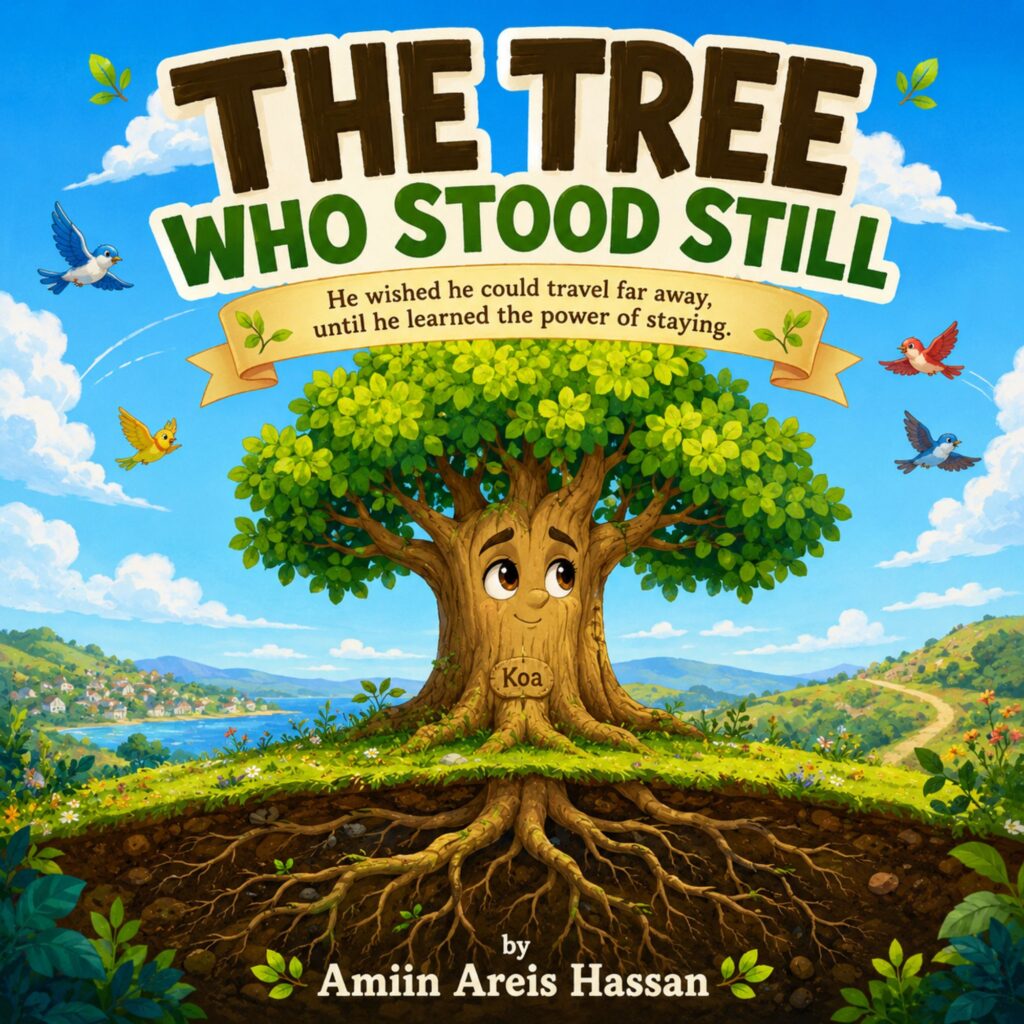
Most children have felt it without having words for it. Someone else gets to go somewhere. Someone else moves faster, travels further, does more. You stay. Koa, the young tree at the center of this picture book by Amiin Areis Hassan, knows that feeling well. He grows on a soft green hill, watches clouds cross the sky and rivers run far away, and quietly wishes he could travel too. This children’s story about inner strength does not brush past that wish or tell Koa he is wrong to feel it. It sits with him there for a while. And when the answer comes, it does not arrive as a consolation prize. It arrives as something Koa discovers for himself, underground, where nobody was watching.
The book is aimed at children ages 4 to 10. It is short enough for a preschooler and deep enough for a ten-year-old to find something new in it each time. Parents and teachers looking for a read-aloud that handles feelings of inadequacy without being preachy will find it here.
What Is The Tree Who Stood Still About?
Koa grows on a green hill. Birds rest in his branches. Warm wind moves through his leaves. It looks like a quiet, full life. But Koa watches everything around him travel clouds, rivers, birds and feels the gap between what he sees and what he can do. He tells a bird on his branch that he wants to see the world too. The bird tilts its head and says what is simply true: trees cannot walk.
That exchange is the emotional pivot of the book, and it happens early. There is no cruelty in it. It is just a fact, and facts can sting. Koa sits with that feeling until he meets a much older tree nearby, one with roots that reach deep into the earth. The elder does not explain. He points. Look below the ground, he says. Koa feels his own roots stretching through cool dark soil, reaching farther than he ever realized.
Then the dry season arrives. Grass pales. Flowers droop. Many living things on the hill struggle. Koa does not. His roots find water where others cannot reach. He stays strong. Years pass. He grows tall and wide, and small animals come to rest in his shade. The book ends not with a speech but with a quiet understanding Koa reaches himself: not every strong thing runs fast. Some strong things stay.
What Does This Children’s Book About Strength Actually Teach?
The easy version of this story would give Koa a hidden talent that resolves his sadness. He discovers he can fly, or his leaves turn gold, or the birds tell him he was special all along. That version would be easier to write and easier to forget. This book does something harder. Koa was already built for the life he was living. Nothing needed to change except his understanding of it.
That is the real lesson, and it lands differently at different ages. A four-year-old will feel it as a story about a sad tree who becomes happy. A seven-year-old will start to ask why the roots mattered. A nine-year-old might sit with the harder question underneath: what is the difference between being stuck and choosing to stay?
The book also teaches something concrete about how trees actually work. Koa’s survival during the drought is not a metaphor dressed up as biology. Deep-rooted trees genuinely reach groundwater that shallow-rooted plants cannot access. A tree that has stayed in one place long enough to develop deep roots survives dry seasons that wipe out younger or less established plants. Staying put, in the natural world, is a genuine strategy for resilience. The book gets this right, and children who notice that detail carry something real out of the story.
You might also enjoy: The Owl Who Asked Why, another book from Amiin Areis Hassan, for children who cannot stop asking questions about the natural world.
Why This Book Matters for Children Ages 4 to 10
Children begin comparing themselves to peers earlier than most adults expect. By age three, many show genuine distress when a sibling receives something they do not. By five or six, they are actively tracking where they fall in the social order of their classroom. This is normal developmental behavior, and it is also where a significant amount of childhood unhappiness lives.
What makes The Tree Who Stood Still worth discussing with children is not that it solves that problem. It does not. It offers something more useful: a way of seeing it. Koa measures himself against things that move by nature. Everything he compares himself to was never going to stay still. The book asks, without asking directly: is that a fair comparison? And it lets children sit with that question long enough to find their own answer.
For younger children, ages 4 to 6, the story works as a straightforward emotional journey. Koa feels sad, meets someone wiser, discovers something surprising, and ends the book content. That arc is clear in the illustrations as much as the text, and children who are not yet reading will track it visually.
For ages 6 to 8, the story opens up into a science conversation. Why do roots need to go deep? What happens to shallow-rooted plants during a drought? Children at this age can hold both the emotional story and the natural world explanation at once, and doing so makes both more interesting.
For ages 8 to 10, the philosophical layer becomes accessible. Being stuck somewhere and choosing to stay are genuinely different things. The book does not answer which one Koa experiences. It lets children decide, and then ask which one they recognize in their own life.
The Science Behind the Story: What Children Learn About Roots and Survival
The illustration of Koa’s roots spreading through dark soil underground is one of the most memorable images in the book, and it is scientifically accurate. Mature trees commonly extend root systems two to three times the width of their visible canopy. In periods of drought, those deep roots reach groundwater that grass and smaller plants simply cannot access. The difference between a young tree and an old one is not just size. It is depth, and depth takes time.
Staying in one place allows that depth to develop. A tree transplanted repeatedly never builds the root architecture that lets it survive hard seasons. Stability is a genuine biological strategy, not just a lesson for picture books.
The ecosystem Koa creates by the end of the story is also accurate. A single mature tree can support dozens of species. Birds nest in the branches. Small animals shelter under the canopy. Insects, fungi, and other organisms live in and around the root system. Koa does not just survive the drought. He becomes a habitat, and that transformation took years of staying put to make possible.
A simple follow-up activity for parents or teachers: plant two bean seeds in separate pots. Water one deeply once a week, the other shallowly every day. After three weeks, gently remove both plants and compare the roots. The deeply watered plant will have longer roots reaching toward the water source. It takes about ten minutes to set up and makes the book’s core insight visible rather than just spoken.
How to Use This Book at Home or in the Classroom
At home, the most useful conversation to have after reading is also the simplest. Ask your child: what are your roots? Not the tree kind. The things that help you stay steady when something is hard. A person you trust. A skill you have been building. A place where you feel safe. Children as young as five can answer that question, and the answers are usually worth hearing.
Another approach: after reading, ask your child to list five things they can already do, and five things they already have. Keep it specific to them. Not generic. This is the same reframe the old tree offers Koa, pointed toward a real child, and it does not require any workshop materials.
In the classroom, use the story to launch a unit on ecosystems. Map out every animal that depends on Koa by the end of the book. Then compare that to what a real mature tree supports in nature. The contrast between a young isolated tree and an old established one is a natural entry point for discussions about what time and staying power actually produce.
The story also works well as a social-emotional writing prompt. Ask students to write or draw about a time they stayed with something hard rather than walking away. What did it feel like? What helped? Koa’s story gives them a scaffold, and most children will have a real experience to draw from.
You might also enjoy: a curated list of nature-based picture books for ages 4 to 10, stories that bring the natural world into the classroom without a worksheet.
Discussion Questions for Parents and Teachers
For ages 4 to 6: Why did Koa feel sad at the beginning? What did he find when he looked below the ground?
For ages 6 to 8: Why do you think Koa stayed strong during the dry days when the grass and flowers did not? What was different about him?
For ages 6 to 8: The old tree did not explain everything. He just said “look below the ground.” Why do you think he did it that way instead of giving a long answer?
For ages 8 to 10: Is there a difference between being stuck somewhere and choosing to stay? How can you tell which one it is?
For ages 8 to 10: Koa’s shade and shelter took years to develop. Can you think of something in your life that took a long time before it became useful or meaningful to others?
For all ages: What do you think the last line means some strong things stay?
Similar Books Worth Reading
For children who connected with Koa’s story, these books explore related themes of quiet strength, finding meaning in what you already are, and sitting with hard feelings without rushing to fix them.
The Invisible String by Patrice Karst works well for children who struggle with separation or feeling cut off from the people they love. Beautiful Oops by Barney Saltzberg is a playful take on finding possibility in what first looks like a mistake. The Rabbit Listened by Cori Doerrfeld is about being present for someone going through something difficult, rather than jumping to solve it. Last Stop on Market Street by Matt de la Peña is for children learning to see richness in what they already have. The Invisible Boy by Trudy Ludwig is a quiet story about a child who feels unseen, and what it actually means to be noticed.
Why This Book Belongs on Your Shelf
There is a version of this story that rushes to the lesson, wraps everything up neatly, and sends children away with a smile. This is not that version. Koa’s sadness is real. His wish to travel is real. The book does not dismiss either of those things. It holds them long enough for something more honest to develop.
What children’s story about inner strength actually does that? Not many. This one earns its ending, and it does it in under 200 words of story text. That economy is part of what makes it work.
The illustrations are fully realized and worth spending time with. The cross-section showing Koa’s roots reaching through dark earth is the kind of image children return to. The final spread, animals resting in his shade while Koa watches the clouds with a quiet expression, does not oversell the resolution. He is still a tree. The clouds still move. He just no longer feels small because of it.
A four-year-old reading this with a parent will take one thing from it. That same child at eight will find something different. That kind of staying power in a picture book is worth paying for, and worth keeping on the shelf past the age it was technically written for.
You can find The Tree Who Stood Still and the full collection of books by Amiin Areis Hassan at zolopi.com. For classroom orders or any questions, reach out at info@zolopi.com.