Children's Book
The Crow Who Learned to Wait: A Children’s Book About Patience, Observation, and the Wisdom of Slowing Down
Every bird in the valley had something to show for itself. The falcon was the fastest. The parrot was the loudest. The hummingbird never seemed to stop moving at all. And then there was Seun the crow, who mostly just sat on his branch and watched. The other birds had a word for that. They […]
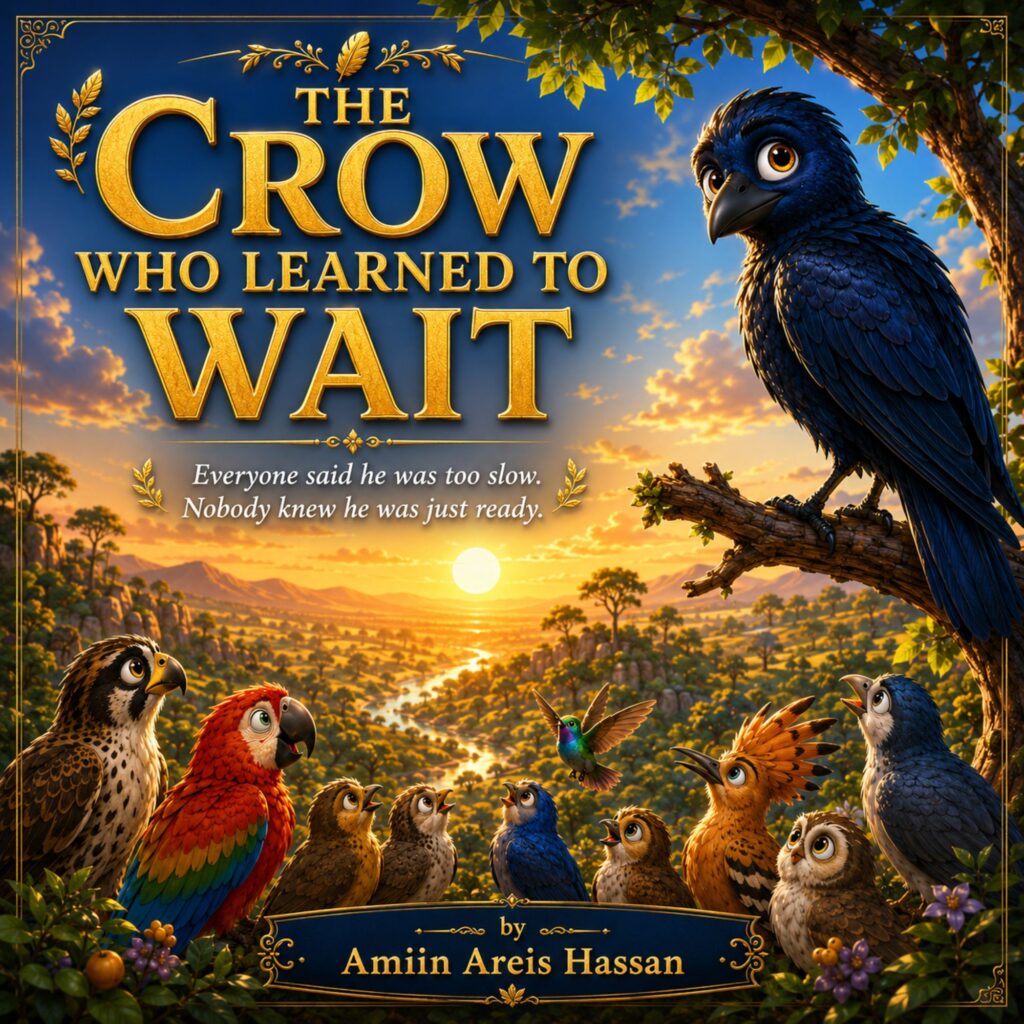
Every bird in the valley had something to show for itself. The falcon was the fastest. The parrot was the loudest. The hummingbird never seemed to stop moving at all. And then there was Seun the crow, who mostly just sat on his branch and watched. The other birds had a word for that. They called it lazy.
They were wrong. But it takes the whole book for them to find out why, and the way they find out is the best part.
The Crow Who Learned to Wait, written by Amiin Areis Hassan, is a children’s book about patience that does not reduce patience to sitting quietly until something nice happens. It shows patience as a skill with a method behind it: watch until you know more than you need to, then wait until the moment is ready. Seun does not succeed because he is calm. He succeeds because he is paying attention, and paying attention takes more work than anyone around him recognizes. The book is aimed at ages 4 to 10, but the idea at its center is one that most adults are still working on.
This is the book for a child who is told they are too slow. Or too quiet. Or not doing enough. It is also the book for the fast one, the loud one, the one who moves before thinking, once they are ready to hear what it actually costs.
What Seun Is Actually Doing While He Sits
The other birds think Seun is doing nothing. He is watching a farmer plant seeds in a field below. He counts the rows. He notes where the farmer goes. He observes the pattern, stores it, and then does something that is genuinely hard: he waits.
Three days pass. The other birds forget the field entirely. Seun does not forget anything. On the fourth morning the farmer returns with a basket of fruit, sets it down, and walks away to get water. Seun has anticipated exactly this moment. He glides down in four wingbeats, takes three figs, and is back on his branch before the farmer turns around. Precise, quiet, complete.
The next day the falcon tries the same field. He dives too fast, knocks the basket over, and flies off with nothing. The parrot calls out so loudly that the farmer comes running. Both go home hungry.
The contrast is not about speed versus slowness. It is about information versus impulse. Seun had more information than he needed before he moved. The falcon and parrot moved on impulse and lost everything they came for. The book makes this visible without ever being preachy about it.
When the falcon asks how Seun always knows when to move, Seun gives an answer worth memorizing: “I watch until I know more than I need to. Then I wait until the moment is ready.” The falcon says that takes so long. Seun says: yes. That is the whole point.
You might also enjoy: The Bee Who Asked Why, another book from Amiin Areis Hassan, about a young bee who discovers that understanding the reason behind what you do completely changes how well you do it.
The Science Behind Seun: What Crows Actually Do
The behavior described in this book is not invented for story purposes. Crows are among the most cognitively sophisticated birds on earth, and their actual behavioral repertoire is remarkably close to what Seun demonstrates.
Crows possess what researchers call episodic-like memory: the ability to remember not just that something happened, but where it happened, when it happened, and what the circumstances were. A crow that watched a farmer bury something would be capable of remembering the exact location, the time elapsed, and the behavioral pattern of the person involved. This is not a simplified version of crow behavior for a children’s book. This is what crows do.
Crows also demonstrate strong performance on delayed gratification tasks, which are tests of the ability to resist an immediate reward in order to gain a larger or better-timed one. In laboratory settings, crows will reliably wait longer than many mammals, including some primates, when the delayed option is clearly better. The behavior Seun demonstrates, waiting four days while other birds move impulsively, maps directly onto how crows actually operate.
The observational patience shown in the fig scene is also consistent with documented crow behavior. Crows have been observed tracking individual humans over extended periods, recognizing their behavioral patterns, and using that information to time their own actions. They learn routines. They anticipate outcomes. They exploit windows of opportunity with precision that feels, to human observers, almost calculated.
What children absorb from this, before they know any of the science, is that watching carefully is a form of intelligence. Seun is not slow. He is thorough. The distinction matters enormously, and the book earns it through story before any adult needs to explain it.
Why This Book Matters for Children Who Are Told They Are Too Slow
Most educational environments and most social settings reward visible speed. The student who raises their hand first. The child who speaks most loudly. The one who finishes before anyone else. These signals of performance are not the same as signals of understanding, but they are treated as if they are, and children notice.
Children who process more slowly, who watch before acting, who take time to be sure before committing to an answer, often receive feedback that is technically about behavior and emotionally experienced as about worth. You are too quiet. You take too long. Why can’t you just try?
This book does not rescue those children by saying they are secretly special. It does something more useful: it shows the actual mechanism by which their approach produces better outcomes. Seun does not succeed despite his patience. He succeeds because of it, and the success is specific and earned, not magical. He gathered information the other birds did not gather. He timed his action to a moment the other birds did not wait for. His outcome was better in a measurable way.
The dry season sequence is where the book becomes something larger than a lesson about patience. When food gets scarce and the fast birds search everywhere and find little, Seun already knows exactly where three water sources are and which trees still have fruit. He had been watching the valley for weeks. He leads everyone there, including every bird that once called him slow. The same quality they mocked becomes the thing that saves them all.
That arc does not require explanation. It speaks for itself. And for a child who has been told they are too slow too many times, watching it unfold is genuinely satisfying.
What This Book Teaches at Different Ages
For children ages 4 to 6, the story works through its clear emotional arc. Seun is mocked. Seun does something quietly clever. The fast birds fail. Seun succeeds. That sequence is satisfying in a way children understand without analysis, and the illustrations carry Seun’s stillness and the other birds’ frantic energy in ways that do not need words to land.
For ages 6 to 8, the observation and memory aspects of the story open up real science conversations. Why do crows sit and watch? What are they actually doing? How do they remember so many things? Children at this age are often fascinated to discover that the crow’s quiet watching is deliberate, purposeful, and more sophisticated than the falcon’s speed.
For ages 8 to 10, the line Seun delivers at the end of page ten is worth sitting with: “Most people think waiting is the same as doing nothing. It is the hardest kind of work there is.” That is a genuinely complex idea. Waiting with purpose, collecting information, resisting the pressure to move, sitting with uncertainty while building a picture of what is actually true: these are skills that most adults struggle with and most children are never explicitly taught.
The book’s final saying, adopted by all the birds of the valley, is the distillation: “When you do not know what to do, watch and wait like Seun. Not because doing nothing is wise. Because knowing when to move is the wisest thing of all.” That formulation is precise enough to be useful. Seun is not advocating passivity. He is advocating informed readiness.
How to Use This Book at Home or in the Classroom
At home, the most immediate activity after reading is to try what Seun does. Pick one thing in your environment and observe it carefully for ten minutes without doing anything else. A bird feeder. A busy street corner. A sibling. A family pet. What do you notice at minute one that you did not notice at minute ten? What changed? What patterns emerged? This is a short, simple exercise that demonstrates Seun’s method in direct experience rather than just story.
Another conversation worth having: ask your child when they have moved too fast and wished they had waited. Most children have a version of the falcon’s story somewhere in their recent memory, a moment where speed cost them something. The book gives them language for why that happened and what a different approach might have looked like.
In the classroom, this book anchors a rich discussion about learning styles, attention, and the difference between visible effort and actual understanding. Not all engagement looks the same. A student who is sitting still and watching is not necessarily doing nothing. A student who is constantly moving and responding may not be processing anything deeply at all.
The patience exercise Seun sets for the falcon and parrot, sitting still for one full hour, can be adapted as a classroom mindfulness or observation activity. Falcon lasted twelve minutes. Parrot lasted four. Ask students: how long do you think you could last? What did you notice when you tried? Seun’s response to their failure is also worth discussing: he does not mock them or say they are hopeless. He says they already know more than they did, and to try again tomorrow. That is what good teaching actually looks like.
You might also enjoy: The Fish Who Could Not See Water, another book from Amiin Areis Hassan, about a young fish who discovers that the most important things in life are the ones you have stopped paying attention to.
Discussion Questions for Parents and Teachers
For ages 4 to 6: Why did the other birds think Seun was lazy? What was he actually doing?
For ages 4 to 6: What happened when the falcon tried the same thing as Seun? Why did it not work?
For ages 6 to 8: Seun counted the rows and remembered where the farmer went. Why was that important? Have you ever remembered something carefully and been glad you did?
For ages 6 to 8: Why do you think the other birds forgot about the field, but Seun did not?
For ages 8 to 10: Seun says waiting is the hardest kind of work there is. Do you agree? What makes it hard?
For ages 8 to 10: The birds who called Seun slow were the ones he had to rescue in the dry season. What does that tell you about how useful fast and slow actually are?
For all ages: Have you ever rushed into something and wished you had waited? What happened?
Similar Books Worth Reading
For children who connected with Seun’s story, these books explore patience, observation, and careful thinking from different directions.
Zen Shorts by Jon J. Muth is a quiet, beautiful book about three children who meet a bear that tells stories with lessons about stillness and perspective. What Do You Do With a Problem? by Kobi Yamada is a companion piece for children who tend to rush at problems and find that a different approach changes everything. The Dot by Peter H. Reynolds is for children who hesitate before starting something new, showing that the waiting and watching before a first mark can be part of the creative process. Beautiful Oops by Barney Saltzberg reframes apparent failures as information rather than endings. Crow Boy by Taro Yashima is an older classic about a child who is dismissed for being different and quiet, and what that dismissal costs everyone around him.
Why This Book Is Worth Reading More Than Once
There is a version of patience that adults teach children out of necessity rather than conviction: just wait, your turn will come, be patient. It is usually offered as a form of management rather than wisdom, and children sense the difference.
This book is different. Seun is not patient because he is waiting his turn. He is patient because he understands that acting before you have enough information is almost always worse than waiting until you do. That understanding changes patience from a form of submission into a form of power. It is not about who moves first. It is about who moves at the right moment.
Every morning at the end of the book, Seun still sits on his branch, still tilts his head, still watches the valley with his quiet amber eyes. Nothing has changed about how he works. What has changed is that everyone around him now understands what that work actually is. The valley adopted a saying because of him. The birds who called him lazy came to him when they were afraid.
That is what patient observation produces: not recognition in the moment, but indispensability when it counts.
You can find The Crow Who Learned to Wait and the complete collection by Amiin Areis Hassan at zolopi.com. For classroom orders and educational partnerships, contact info@zolopi.com.