Children's Book
Mira and the Heavy Leaf: A Children’s Book About Asking for Help and Finding Real Strength
Mira the small turtle always tried to do everything alone — until a leaf too big to carry changed everything. A warm, funny story about teamwork and friendship for children aged 4 to 8.
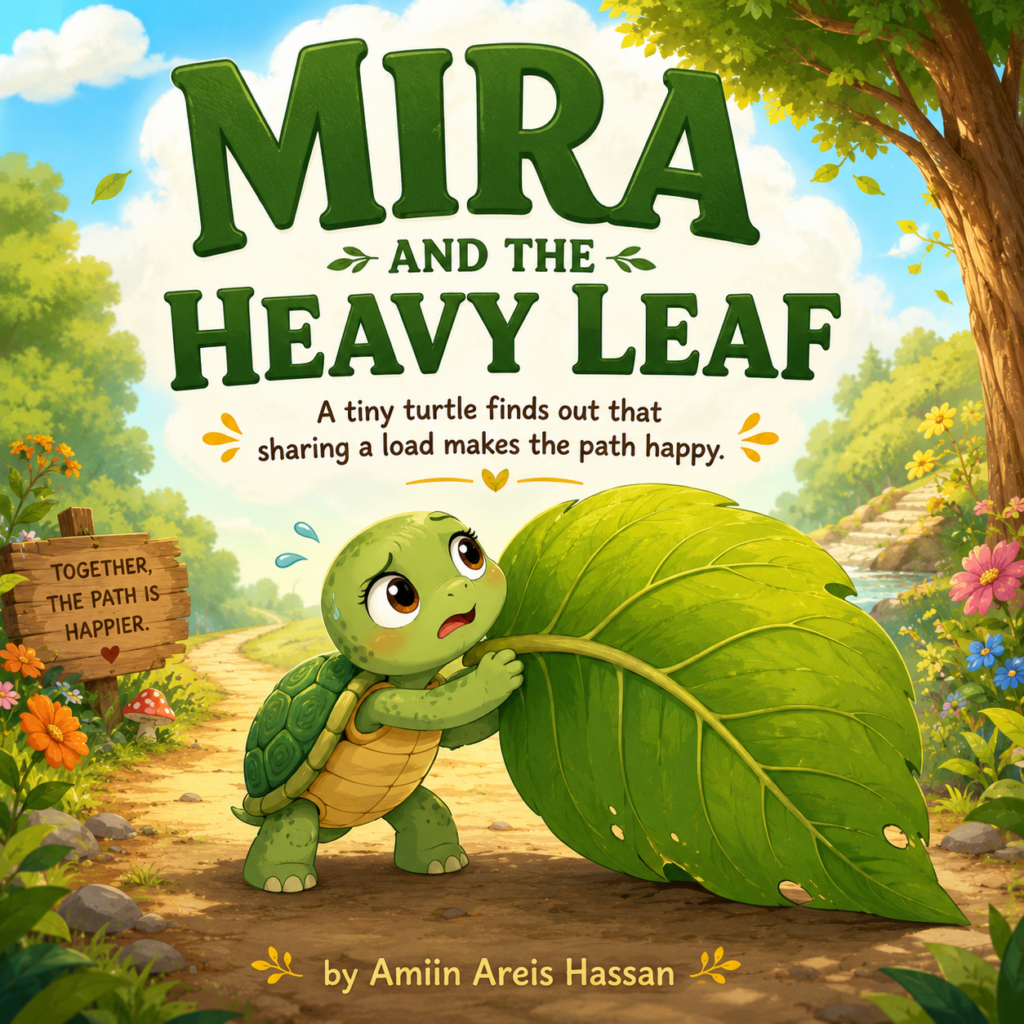
Mira is a small green turtle who always tries to do everything by herself. She walks slowly through the soft grass by her clear pond. She is careful and steady and proud. She thinks doing things alone is what makes her look big and strong. Most children who have ever refused help because they wanted to prove something will recognize that feeling without being told to.
One morning Mira finds the most perfect leaf she has ever seen. It looks sweet and good to eat and she wants to bring it home. She pushes it with her small front feet. The leaf does not move. She tries again. Her legs feel tired. A small brown snail passes by and offers to help. Mira shakes her head. She can do it alone. She does not want to ask for help.
What happens next is the most honest moment in Mira and the Heavy Leaf, a picture book written by Amiin Areis Hassan for children ages 4 to 10. Mira pushes so hard that she tips over. She lands on her back in the warm dirt. Gravity makes it impossible for her to turn around. She feels small and a little bit scared. The snail she refused has to come back to help her anyway, along with a new turtle friend, and together they flip her right side up. Then the turtle suggests something simple: carry the leaf together. Mira nods. They take one side each. The leaf feels light. They reach her home quickly. They share the food with the snail too. Everyone feels full and happy.
This is a children’s book about asking for help that respects the reason children do not want to. It does not treat Mira’s pride as a character flaw to be corrected. It treats it as a natural feeling with a real cost, and it lets that cost arrive without softening it. She ends up on her back in the dirt. That is not a gentle consequence. It is the honest one.
Why Asking for Help Feels Hard: The Psychology Behind Mira’s Refusal
Mira does not refuse the snail’s help because she is stubborn in an unreasonable way. She refuses because she has built her sense of herself around a particular idea: doing things alone makes you strong. That belief feels true to her. It probably felt earned. And it is not entirely wrong. Independence is a real skill and a real source of confidence. The problem comes when independence becomes an identity that cannot bend.
Child psychologists who study help-seeking behavior in young children have found that the reluctance to ask for help often increases between ages four and seven, precisely as children are developing stronger senses of their own competence. A child who could not do something and now can is understandably proud of that. The same child, offered help with the next challenge, may read that offer as a suggestion that they cannot do this one either. Mira hears the snail’s offer exactly that way. She does not want to need help.
What the book does well is show that this is not a character problem but a thinking problem. Mira’s legs are genuinely strong enough to carry a leaf. They are just not strong enough to carry that particular leaf, which is much bigger than her. The issue is not her strength. It is her unwillingness to accurately assess what the situation actually requires.
That distinction matters for children because it preserves the thing they are trying to protect. Mira does not end the story weak. She ends it stronger, fed, surrounded by friends she now has because she accepted help. Accepting help did not diminish her. It multiplied her.
You might also enjoy: The Bee Who Asked Why, another book from Amiin Areis Hassan, about a young bee who discovers that asking questions and sharing knowledge makes the whole hive better at what it does.
The Science in the Story: Gravity and Shared Force
The book introduces gravity in a way that is accurate and age-appropriate. When Mira first tries to push the leaf, the text tells her it is very heavy because gravity pulls everything down to earth. That explanation is correct. Gravity is a force that attracts objects toward the center of the earth, and the heavier an object is, the more gravitational force it experiences. A large leaf is genuinely harder to move than a small one because there is simply more mass for gravity to pull on.
The second science moment arrives when Mira is on her back and cannot right herself. Gravity makes it impossible for her to turn around. This is also accurate. A turtle on its back faces a genuine mechanical problem: the curve of the shell acts against the motion needed to flip upright, and gravity holds the weight of the shell down. Without an external force to help, a turtle on its back can be genuinely stuck. The book does not dramatize this or turn it into a dangerous situation, but it does treat it honestly.
The most satisfying science moment is the one that resolves the story. With two turtles pushing, the leaf felt very light. Gravity was still pulling it down, but their shared strength was bigger. That is a clean introduction to the concept of net force: when multiple forces act on an object, what matters is the total. Two turtles pushing together produce more force than one turtle alone, enough to overcome the gravitational pull on the leaf. The leaf does not get lighter. The force applied to it gets larger.
Children who understand this carry a useful frame into the rest of their lives. Problems do not always get easier. Sometimes the only thing that changes is how many people are working on them together.
Why This Book Works for Children Who Struggle to Ask for Help
Not all children who refuse help do so for the same reason. Some are afraid of looking incompetent. Some have been told, directly or by example, that needing help is a weakness. Some have simply never had the experience of asking and receiving, so they do not know what it feels like. And some, like Mira, have built an identity around self-sufficiency that feels genuinely threatened by the idea of relying on someone else.
This book addresses all of those versions without targeting any of them specifically. It does not say Mira was wrong to want to be independent. It shows what happens when that want overrides her judgment. And it shows the alternative not as surrender but as strategy. Asking for help is not the opposite of strength. It is one of the tools strong people use.
The snail’s patience is worth noticing. After Mira refuses, the snail does not leave. When Mira tips over, the snail comes back. The snail does not make Mira feel bad about her earlier refusal. There is no “I told you so.” There is just a small creature crawling back to help someone who needed it. That is the kind of friendship children respond to, the kind that does not keep score.
Mira learned that asking for help does not make you weak. It actually connects you to others and makes you stronger. That is the book’s central lesson, and it lands because the story earns it through a sequence of real events rather than stating it as a principle and moving on.
For children ages 4 to 6, the story works through its physical comedy and warmth. Mira upside down in the dirt is funny in the way that only children’s books can be. The image of two small turtles carrying a big leaf together is satisfying in a way that needs no explanation.
For ages 6 to 8, the science provides a new layer. Why was the leaf so heavy? Why could Mira not flip herself? Why did it feel lighter with two? These questions have real answers, and the book opens them naturally.
For ages 8 to 10, the more interesting question is Mira’s original belief: that doing things alone makes you look big and strong. Where did that idea come from? Is it ever true? When does it stop being true? Older children can engage with that as a genuine question about how they think about strength.
How to Use This Book at Home or in the Classroom
At home, the best conversation to have after reading is about a time the child refused help they needed. Not to judge it, but to understand it. What did it feel like to refuse? What were they afraid of? What happened? Most children have a story that maps closely onto Mira’s, and the book gives them a way to tell it without feeling criticized.
A practical activity for younger children: try carrying something heavy across a room alone, then ask another person to help. Notice the difference. Not just in effort but in how the task feels. That physical experience of shared weight is the book’s central insight made tangible.
In the classroom, Mira and the Heavy Leaf works naturally alongside lessons on forces and motion. Objects at rest stay at rest unless a force acts on them. Larger objects require more force to move. Multiple forces combine. Each of these concepts appears in the story, and children who have read it will remember them more readily because they are attached to a character they care about.
The book also works well as part of a social-emotional learning unit on asking for help and working cooperatively. The snail’s offer, Mira’s refusal, and what follows create a clear case study. Ask students: what would have happened if the snail had not come back? What made the snail come back? What kind of friend is that?
You might also enjoy: Sol and the Hidden Root, another book from Amiin Areis Hassan, in which a young fox discovers that the trees around him have been quietly helping each other underground the entire time.
Discussion Questions for Parents and Teachers
For ages 4 to 6: Why did Mira not want to ask for help? Have you ever felt like that?
For ages 4 to 6: Why could Mira not move the leaf by herself? Why was it easier with two?
For ages 6 to 8: Mira said doing things alone made her look big and strong. Do you think that is true? Is there a difference between looking strong and being strong?
For ages 6 to 8: The snail came back to help Mira even after she said no. Why do you think the snail did that?
For ages 8 to 10: Mira believed that needing help made her weak. Where do you think that idea came from? Is it ever true?
For ages 8 to 10: At the end, Mira and her friends shared the leaf with the snail too. Why is that detail important? What would the story mean if they had left the snail out?
For all ages: What is something heavy you are carrying right now that might feel lighter if you asked for help?
Similar Books Worth Reading
For children who connected with Mira’s story, these books approach asking for help, friendship, and working together from different angles.
The Rabbit Listened by Cori Doerrfeld is a quiet story about what it looks like when someone is truly present for you without trying to fix anything. Enemy Pie by Derek Munson is about the unexpected results of letting your guard down and letting someone in. Dragons Love Tacos by Adam Rubin is lighter and younger but captures the joy of doing something together that you could not do alone. What Do You Do With a Problem? by Kobi Yamada is a thoughtful companion for children who tend to face challenges alone and find that approaching problems differently changes everything. How to Catch a Star by Oliver Jeffers is for the very young child who wants something very much and finds, eventually, that the way to get it is not the way they expected.
Why This Book Belongs in Every Classroom
There are plenty of children’s books about teamwork. Most of them start with a group and show how they accomplish something together. This one starts with a child who will not be in the group and shows what that costs her. That is a more honest starting point, because most children who struggle to ask for help do not lack the knowledge that teamwork is good. They lack the emotional permission to need it.
Mira gives them that permission. Not by arguing for it, but by living through the alternative. She ends the story full, warm, surrounded by friends, holding a piece of leaf she could not have carried home alone. None of that required her to stop being strong. It just required her to expand her idea of what strong means.
Children who read this book walk away knowing one thing they did not know before: asking for help does not make you weak. It connects you to others. And in the end, that connection is what made the leaf feel light.
You can find Mira and the Heavy Leaf and the complete collection by Amiin Areis Hassan at zolopi.com. For classroom orders and educational partnerships, contact info@zolopi.com.